Sunday, July 05, 2020

Spy Game S01E08 - "And That About Concludes Our Session" (Jul 5, 1997)


Posting the 8th episode of Spy Game which premiered 23 years ago on this date of July 5th. Enjoy!


Summary


It is not a good time if your chosen profession is spy. The Cold War has ended, and spies are no longer in high demand. While ex-Secret Agent Lorne Cash is trying to determine what to do next, he is requested by the President to assist the Emergency Counter Hostilities Organization. A young rookie member of ECHO, Maxine 'Max' London, is assigned to be his partner. This late era spy must now become accustomed to the modern era "Spy Game".


Synopsis

Dr. David Lynk, a psychotic former psychiatrist with a multiple personality disorder, breaks out of the lunatic asylum bent on murdering his former patients.


Other Spy Game episodes posted:


  • Spy Game S01E11 - "Necessity is the Mother of Infection" (unaired in USA)


  • Sunday, June 28, 2020

    Spy Game S01E07 - "What Family Doesn't Have Its Ups and Downs" (Jun 28, 1997)


    Posting the 7th episode of Spy Game which premiered 23 years ago on this date of June 28th. Enjoy!


    Summary


    It is not a good time if your chosen profession is spy. The Cold War has ended, and spies are no longer in high demand. While ex-Secret Agent Lorne Cash is trying to determine what to do next, he is requested by the President to assist the Emergency Counter Hostilities Organization. A young rookie member of ECHO, Maxine 'Max' London, is assigned to be his partner. This late era spy must now become accustomed to the modern era "Spy Game".


    Synopsis

    Lorne and Max escort half a billion dollars in relief funds to an earthquake disaster area. Lorne's traitorous brother, Jim, turns up with plans to steal the money.


    Other Spy Game episodes posted:


    Sunday, June 21, 2020

    Spy Game S01E06 - "What, Micah Worry?" (Jun 21, 1997)


    Posting the 6th episode of Spy Game which premiered 23 years ago on this date of June 21st. Enjoy!


    Summary


    It is not a good time if your chosen profession is spy. The Cold War has ended, and spies are no longer in high demand. While ex-Secret Agent Lorne Cash is trying to determine what to do next, he is requested by the President to assist the Emergency Counter Hostilities Organization. A young rookie member of ECHO, Maxine 'Max' London, is assigned to be his partner. This late era spy must now become accustomed to the modern era "Spy Game".


    Synopsis

    When Micah is fired for leaking top-secret military technology to arm dealers, Lorne and Max can't believe the charges and investigate. They discover that Micah has gone undercover to learn the identity of the real traitor.


    Other Spy Game episodes posted:


    Thursday, June 18, 2020

    How Bruce Lee Trained His Quick Kill by Badger Johnson


    I've had another new insight into Bruce Lee and his ability and training.

    If you want to be the 'best' at the one thing that martial arts is supposed to be able to do, what three things would you spend time developing?

    And it's not 'movie martial arts' I'm talking about.

    The one thing that martial arts is supposed to be able to do is to kill someone rapidly. The truth is Bruce Lee trained SPECIFICALLY to be able to kill someone in 1-2 seconds.

    1. Having specific targets and apparatus that allow one to explode full power into them and generate the real ability to do a shock-power kill shot. James Yimm Lee built him these gadgets.


    Very few people train exactly what is needed to do a quick kill AND test it out on specialty equipment.

    People hit things, hit other people but there is gear, rules, non-specific stuff. You need super feedback. Just how hard does that hit? How fast? How easy to block? Can it penetrate or are you guessing? Gotta take all guesswork out and make it 'sure'.

    Bruce Lee training on a gadget James Yimm Lee built for him.

    Obviously you can't actually kill people but you could come close with specific gear as to what is needed.

    Lee's method was to overtrain. Dan Inosanto has said that Lee was training to poke his fingers through a thin steel drink can so that he can puncture a person's body, eyes, neck, etc.

    2. Having the ability to generate 'kill intent'. This is key and is where I failed until I made myself a 'kill word'. Lee specifically trained with a hypnotist (interestingly James DeMile) to develop a self-hypnotic kill word such that when he thought it he could go from 'sitting on the couch mellow' to wanting to rip your head off and drop kick it out the window. A kill word is ESSENTIAL and anyone who plans to do hand-to-hand self-defense (which I don't) should have one and have practice calling it up. We see Lee doing this on screen when he goes from normal to demonic.

    Badger Johnson:  "You can see him go from near-peaceful
    to sudden rage right on screen and you can't fake that."

    3. The ability to stage or set things up so that you are in charge of the situation and can put the opponent in the least favorable position. Lee was a master of staging things from having a lot of charm and being able to lure you in to his paradigm, to being able to hold back until the last minute making the opponent think they are safe and then suddenly hitting demonic mode and exploding into them so they have no chance.

    Smiling with charm to disarm and then suddenly explode in demonic mode.


    He did these three things which I don't think anyone else did (besides Sonny Umpad - which people talk about his 'dark side').

    Now, going back to what I said, NONE of those people specifically trained to have a 1-2 second kill capability, which included developing a 'kill word', and having machines specifically built to allow him to train those skills, which nobody else was doing. He also understood how to set things up to his benefit and he knew how to lure people in with charm and personality. He also had a temper, which he knew about, and he had some trouble controlling it.

    None of these other people worked with a hypnotist to develop a kill-word. None of these people trained to kill their opponents in a matter of an instant. But you have to have the right venue and that is not an octagon and padded gloves. It's not a large area where people are surrounding someone in a circle.

    What Lee could not do was the majority of things we saw in his movies. He couldn't fight 10 guys in a circle (realistically) and beat them all. He couldn't jump up into trees. He had little to no acrobatic skills (that was his stunt double Yuen Wah), and he didn't train to kill or hit people (realisitcally) with things like the nunchuks. That was all stage fighting.

    Yuen Wah doubling for Bruce Lee's acrobatics in Enter the Dragon.

    Most of what he did in his movies was stage fighting, just like when you see old time fencing movies, that's all stage fighting.

    Chuck Norris was good, but he was not Bruce Lee good. But he did do a lot of tournament fighting and he might have been able to outpoint Lee in a more-or-less friendly sparring match.

    So there it is right out there in plain sight. And for years people missed it because...well because they're not homicidal maniacs.

    In other words, Chuck might have been a good kicker, a good tournament fighter and even served in the military but he did not train to be able to really kill someone, with very specific methods in 1-2 seconds. Lee did.

    "I fear not the man who has practiced 10,000 kicks once, but I fear the man who has practiced one kick 10,000 times."
    ~Bruce Lee
    Again, amazing how most of the stuff is right out there in plain sight but we were not seeing it. Same thing with the comment that Jesse Glover and others had made that when someone showed Lee something and he came back in a day or two, having done 10,000 to 100,000 repetitions of that move and he was better at it than the guy who showed it to him. We only see him in kind of posed, passive looking pictures of him throwing a finger jab. But in reality in demon mode working that machine which James Lee built would look quite frightening.


    © Badger Johnson


    Please check out Badger Johnson's other essays:


    Sunday, June 14, 2020

    Spy Game S01E05 - "You Just Can't Trust Anyone These Days" (Jun 14, 1997)


    Posting the 5th episode of Spy Game which premiered 23 years ago on this date of June 14th. Enjoy!


    Summary


    It is not a good time if your chosen profession is spy. The Cold War has ended, and spies are no longer in high demand. While ex-Secret Agent Lorne Cash is trying to determine what to do next, he is requested by the President to assist the Emergency Counter Hostilities Organization. A young rookie member of ECHO, Maxine 'Max' London, is assigned to be his partner. This late era spy must now become accustomed to the modern era "Spy Game".


    Synopsis

    When a four-star general hypnotizes Max, turning her into an assassin, Lorne and Micah must prevent the President's murder, capture Max and save her.


    Other Spy Game episodes posted:


    Monday, June 08, 2020

    Fighting Fit Part 2 - The Seven Essentials by Badger Johnson


    This essay is about the seven essential abilities (plus intangibles) of being fighting fit. It is a follow-up to Not Martial Trained, But Fighting Fit.


    Consistency, Frequency, Duration, Intensity, Sustainability, Specificity, Adaptability plus Intangibles 


    Consistency
    Including the ability to have enough interest and ease that it can be done as a daily activity and not lose appeal.

    Frequency
    Including the ability to recover and do active recovery such that taking days off is not really necessary. In addition the ability to do it twice a day (such as riding to work, or doing two-a-day workouts) is easy and interesting.

    Duration
    Within a range duration can be as low as 30 minutes, and as long as 90 minutes but after about 45 minutes, there are diminishing returns with regard to training effect and recovery, as well as risking becoming a chore or onerous.

    Intensity
    It’s well known among bikers and joggers that there is a ’no-man’s-land’ in training intensity where you are working too hard to allow good recovery and enjoyment or progress that isn’t available through frequency and duration (long, steady distance), and an optimal point for improving VO2max or burst which only needs to be done at infrequent (but consistent) intervals. In addition there is a ‘pacing’ component where intensity and recovery are modulated. Burst, recover, burst, recover while trying to decrease rest and increase tempo or intensity or speed. Various tricks you can do on a bike are things like moto-pacing where you ride behind a car and then break out and try to keep up that speed. This is something you can’t really do while jogging and it allows you to adapt to the higher workload by gaining experience and increasing expectations.


    "One of the most important things ... is that an activity has to be sustainable." 


    Sustainability
    One of the most important things that allows the above attributes especially consistency and frequency is that an activity has to be sustainable. There is the short term sustainability of an activity often perceived as fun, and the long-term sustainability which includes the ease and enjoyment and lack of injury periods.

    Some people have good sustainability in jogging but if they are not biomechanically able to do that over a long period without breakdown of joints and connective tissues, and the pounding of the feet take in this medium impact activity, it can’t be sustained well into advanced age as well as cycling or circuit training or even swimming. Interestingly swimming, though of high value in many areas has some downsides with repetitive injury and various issues with swimmer’s ear and problems with chlorine eye problems. In an ideal setup, a routine which included an indoor private pool without other people using it, a jogging track with high tech materials and a bike riding course without the problems of cars or other foot traffic, one could do 30-40 on the bike, 30 minutes of light jogging or maybe repeat intervals for 15 minutes followed by a swim of 300 meters and have a great sustainable routine that might not take more than an hour a day, where the intervals and swimming are only done 3x a week with biking being the mainstay.

    Just like cardio-dancing an activity with high sustainability in the short term, it draws you back in so that you're eager to sweat and get over the burn and keep doing it. So Sustainability has two or more components. Short term, means compelling, joy producing and long term means you can recover and do it again every day. I talk abut how you should measure your activity in terms of 'sessions'. So I could do 330 sessions per year easily which is 26 days a month plus three weeks of two a day and barring weather, get almost twice as many sessions than a 3x a week faithful weight trainer, and weight training day after day is boring over 10 years.

    Specificity
    One of the important things about sustainability might be that it be tied to a sport or a fun activity such that they interconnect and support each other. If you have a favorite sport such as martial arts, tennis, handball, basketball, skiing, horseback riding or even group games, and you find it is improved and enhanced with some base training it adds to the ability to sustain it over a lifetime.


    Photo credit:  Shutterstock/Active Stock

    Adaptability
    The activity has to be something that can adapt to your lifestyle, your time constraints, availability of the activity (good roads or good skiing slopes or good running areas) and have that important element of safety. It’s important to consider that not all people thrive at the same level at an activity or at base training in general. Some people live to surf and will do everything and anything to get out there on that wave. Similarly some will find that downhill skiing gives a similar impulse or drive. Some of that might be due to biochemical differences or genetic gifts. (See the essay, The Safecracker and the Fighter, on high risk activities and being dopamine-based receptors vs serotonin-based receptors.)


    Intangibles and essentials - by intangibles I don’t mean hard to define but things which are part of a support system, helping recovery and defining motivation and mental aspects.

    Motivation - training partners. Drive, energy, urgency, payoff, high risk/low risk individuals.

    Diet and tracking - diet requires good food selection, a purpose and plan and that requires some tracking of foods and bodyweight. Along with this comes intelligent use of vitamins and supplements.

    Belief in your system and yourself - part of stress reduction and also motivation is that you have a belief in the efficacy and value of your training systems, while at the same time being able to move and transition as required. Obviously going out and doing someone else’s system is not as beneficial as being able to design and understand your own system. Part of this and of motivation is learning how to self-coach, learning what motivates you and what is de-motivating.

    Mental aspects - moving meditation, breathing and self-affirmations.

    Non-injurious - one of the most important parts of an activity has to be a low potential for injury.

    Low, high and no-impact activities - due to the importance of maintaining bone density, we must include some medium impact activities and not focus only on low impact, like cycling and swimming and rowing and doing an elliptical. Sometimes one’s sport serves this purpose sometimes a fun activity can help, and sometimes you have to be creative or just find it in walking or stair climbing.

    Photo credit:  Shutterstock/BigFootSLV

    Rest and sleep - we improve with rest and the output of human growth hormone comes during periods of 45 minute naps in a dark room.

    Research and development - keeping up on the research available to allow improvements in routine, rest, nutrition or equipment. It’s important to know when you should replace your equipment (shoes) and have the right fit in things (bike fit).

    Cost - the best activities have low cost or one time costs. Some, such as gym memberships, fees, lift tickets, expensive gear can have an impact.

    Breathing - one of the crucial aspects is the ability to breathe. You can use nose only breathing to center yourself and improve positive affirmations, you can use breath-hold methods to rapidly improve and test cardiovascular ability.

    Testing - testing would include having an event, such as timed course, a fun run, a race, or an activity (such as swimming underwater for distance). It’s important to explore periodic testing as well as learning how to taper an activity so you can experience supercompensation.

    Photo credit:  Shutterstock/Rey Borlaza

    An aside about cardio, when I was in my late teens and was in good cardio shape, and worked at a pool, I would test my ability to swim laps underwater. The best I could do without training it (just tried it a few times) was 2.2 laps in a 25 yard pool. Olympic pools are 50 meters or 162 feet, versus about 165 feet with two turnarounds (which uses up energy). In my 60s I did another test, coming off of a lot of biking and elliptical work, and I did repeats of two laps in a pool or one lap of an Olympic pool we have here in Westmoreland. I was happy to see I could meet the kind of aerobic ability I had (relatively) as a kid. Of course aerobic and anaerobic and burst are used in fighting/rolling/sparring, so on the bike, with hills and sprints you get both types.

    Base-building - why? - Base training gives you the energy, the biochemical traits, the drive and motivation to pursue all other activities. It gives a sense of well-being partly due to reduction of rumination and use of moving meditation and partly due to the release of good neurohormones. The best way to assure motivation is to have the energy to get up and go train and that comes with base building.

    © Badger Johnson


    Please check out Badger Johnson's other essays:


    Sunday, June 07, 2020

    Spy Game S01E04 - "Dead and Gone Honey" (Jun 7, 1997)


    Posting the 4th episode of Spy Game which premiered 23 years ago on this date of June 7th. Enjoy!


    Summary


    It is not a good time if your chosen profession is spy. The Cold War has ended, and spies are no longer in high demand. While ex-Secret Agent Lorne Cash is trying to determine what to do next, he is requested by the President to assist the Emergency Counter Hostilities Organization. A young rookie member of ECHO, Maxine 'Max' London, is assigned to be his partner. This late era spy must now become accustomed to the modern era "Spy Game".


    Synopsis

    Lorne and Max investigate when two dead former agents are found with all their molars removed. They are assisted by retired agent Honey Trapp who teaches Max the art of being a sex kitten to extract information from distracted male targets.


    Other Spy Game episodes posted:


    Tuesday, May 26, 2020

    What is Mobile Kicking? by Badger Johnson


    What is Mobile Kicking?

    The main difficulty in landing a strike, getting an entry, and even getting a takedown is the ability to quickly close the gap between the attacker and the opponent.

    To do so is also an opportunity for the opponent to increase the gap as they sense an attempt. The opponent can do one of three things. He can jam, he can lean back, or he can sidestep. He can also block which is less reliable since it requires almost perfect understanding of the angle and attack being attempted.

    This essay will describe the method of closing the gap known as ‘mobile kicking’.

    The components of mobile kicking can be broken down into a few components:

    1. The dynamic chamber
    2. Unweighting
    3. The subtle skip step


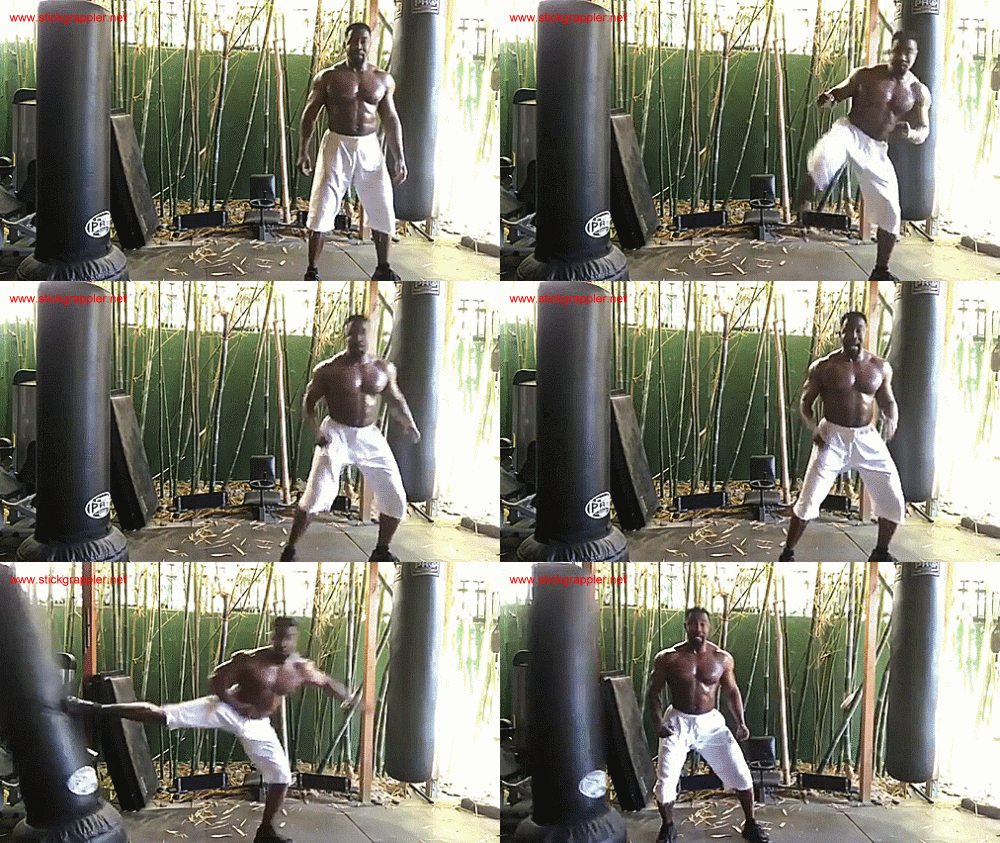
    The purpose of the dynamic chamber is to begin the attack in a non-telegraphic manner, while not disclosing the exact target of any subsequent kick or other attack. The chamber may result in a subsequent kicking attack or it may involve a fake which is followed by a hand strike or even a penetration step to a takedown.

    Unweighting is the movement involved in reducing the friction with the ground by slightly lifting the weight either by a slight dip or a slight rise in the body’s center of gravity. It’s most often seen in skinning as the skier will unweight to get the body weight off of the turning ski, allowing carving a turn.

    In sparring it reduces the friction with the ground of the standing leg allowing a sliding forward which is impelled by the motion of the dynamic chamber (lifting the lead knee).

    The skip step happens not as a conscious movement but as a result of the dynamic chambering and the unweighting, and allows the standing leg to slide forward very quickly in either a straight line or a vector off of the angulation of the body, and causes a near instantaneous closing of the gap, disguised behind the subtle distraction of either a hand feint or fake and the dynamic chamber (which can be a fake or a feint as well).

    You can most easily see the procedure by watching the GIFs of Michael Jai White:

    Sidekick realtime

    Slowmo sidekick

    Spinning back kick realtime

    Slowmo spinning back kick

    Above GIFs made from "Michael Jai White on Covering Distance (part 2) full frame and slower"

    You can also see it in the below 2 GIFs from this video of Raymond Daniels:

    Realtime

    Slowmo

    and an early version in these 2 GIFs (1st, 3rd and 4th kicks) by Bruce Lee against Bob Wall in Return of the Dragon:

    Real-time of the 4 kicks in this scene

    Slow motion on the initiation of the 1st, 2nd and 4th kicks


    Now that you know what mobile kicking is, the next time you see it used you will be like:


    Please check out Badger Johnson's other essays:


    Wednesday, January 01, 2020

    Happy New Year 2020!


    Happy New Year my Friends!

    May you and your loved ones find Health, Happiness and Wealth in 2020!

    Any resolutions for 2020? Please leave a comment.


    Very truly yours in the MA and SD,

    ~ Stickgrappler

    Saturday, June 01, 2019

    What Bruce Lee Taught Us by Badger Johnson


    What BL taught us.

    Development of short power, with the one and three inch punch. Studied Jack Dempsey and his drop-shift. Knew that the key element of patterns was incorporating the body energy or ground-path and not just arm strength, though didn’t say explicitly. However, also discovered a method of bringing short power just by over development of the forearm muscles and the wrist tilt punch.

    Went beyond aphorisms, and flowery sayings, though he did include many from Krishnamurti and Zen sayings. Basically he was one of the first to relate deeper thoughts to personal combat. Others offered thoughts about military goals and tactics or mass combat, like Musashi’s Book of Five Rings and Sun Tzu’s Art of War, but not specifically personal combat.

    Emphasized suddenness over sheer strength. Kinetic energy = 1/2 mv² - meaning the mass is much less significant than the velocity.

    How to make weak things stronger especially those which are weak even on strong men. Upper back muscles, obliques, forearms, neck, abs, calves. He specifically worked on the bridge arm muscles allowing him to keep his arm raised and not pushed down.

    Helped us understand how to analyze what’s important rather than what is showy, though didn’t say how explicitly. Emphasized the individual finding their best methods and abilities.

    That hardening a body part is not the apex of MA. Better to harden a body system, such as wrist and forearm power.

    It was fairly obvious that he was trying to think outside the box and to see outside the box.

    Helps show us the path to self-coaching. Prompted people to analyze their own strengths and weaknesses, and to understand their limitations.

    Mentally and physically explained how the build up was like a pyramid, with a base layer and a diamond-like pinnacle. Each level required the build up of the previous level, ending in a sharp point, beyond what might be possible without base building.

    Adding nutrition and weight training and cross training even more than it was emphasized before.

    How to find the best in other systems and then incorporate into your system.

    He was not successful in getting across the ‘my forte may not be your forte’ - people just wanted to copy him.

    Rather than tell us outright his secrets he dropped hints which made it worth looking deeper. Sometimes it’s better to hint than to just tell everything. IF you tell everything people undervalue it.

    Concepts like ‘Fighting Without Fighting’, ‘Absorb What Is Useful’, ‘Having No Limitation As Limitation’, and other Zen-like sayings were incorporated into the body of knowledge for people to look more deeply into, giving the method more profound implications, and not just a gymnastic routine. (see the essay about the concept of Fighting Without Fighting)

    Some sayings such as ‘Empty Your Cup’ are well-known but were not necessarily applied to combat. ”Obey the principles without being bound by them.” is also a good one, showing that to become great one must follow the principles, then, at the top levels of skill, ultimately break them. Interestingly some of his sayings change as one grows in mastery. ‘Hacking Away at the Non-essential’ may have a different meaning to beginners than to those with higher skill.

    While others were saying to look for hidden meaning in fixed patterns he said ‘The truth is outside all fixed patterns’.

    One thing that it’s important to do is not just to repeat his sayings but delve into the meaning, origin and deeper levels of the concept.

    He figured out how to incorporate things like non-telegraphic action, non-intention movement into his fighting style, and using the ‘fast close’, make them actually work in practice. How do you do non-intention? You catch yourself doing a non-intention move and then reverse engineer it, and break it down for study. You can’t ‘intend’ to do non-intention. Once you have non-intention capability, you can then begin to predict or anticipate others’ movements before they themselves realize they’re doing them. This is one of the basis for ‘Attack by Drawing’ tactics.

    He brought several fencing concepts into combat, among them, the ‘Five Ways of Attack’. He should have said “there may be more ways of attack than just five but you have to find them”. (see the essay on ‘the expansion of the five ways of attack’)

    He taught that there were concepts such as “fitting in” to the opponent’s moves, not just opposing them. He emphasized the need for various types of broken rhythm, timing and tempo. You don’t use broken rhythm you break the opponent’s rhythm.

    Not normally mentioned was that he had the concept of stage presentation or stage magic, or setting up the opponent to fail and himself to succeed. He used this whenever possible to give him a better than even chance to effect his moves and concepts. Such things even work in actual conflict, for example putting the Sun at your back and putting the glare into the opponent’s vision.

    In movies, went from the endless superficial blocking and parrying to dynamic short fights.

    Concept of how to go from zero to sixty in aggression or the use of a kill word and use of self-hypnosis to access the subconscious.

    Realized that hardening body parts is worthless without a delivery system. You may have a hand grenade but if you can’t deliver it to the target it’s not worth much.

    May have realized, though didn’t say directly, that aliveness, i.e. footwork, timing, resistance and energy were important aspects to have and to train. He did talk about all of them though didn’t give an overall concept.

    He realized that for him his talent may have been in fighting but it’s not a very good way (at the time) to make a living so he went into films, instead. The lesson here is that being obsessed with fighting or combat or self-defense is kind of a ‘trap’. You can only sustain your edge or prowess or alertness for a short time. A fighter’s life-span is limited. Using a ‘firing solution’ (striking or engaging) is one of the last best options one should use to resolve conflict.

    A few things he had not yet developed:

    1. Grappling flow and ground fighting flow - his grappling method was more of a collection of tricks than an understanding of rolling and guard and mount.

    2. Mobile kicking - he didn’t have a complete concept for ‘mobile kicking’ which is using ‘unweighting’ and a high chamber position to bridge the gap. There is a sequence in Return of the Dragon where he bridges the gap using a short skip step against Bob Wall. But he doesn’t conceptualize this in his writings. Though he only gains a few inches with that kick it uses the principle of dynamic chambering and unweighting to close the gap and land the technique. I don't believe he understood it as a 'concept' since he had not incorporated it into his other kicks and was still doing the step up and chamber which is intrinsically slower.

    Real-time of the 4 kicks in this scene

    Slow motion on the initiation of the 1st, 2nd and 4th kicks

    3. Transitions - may have had entering to trapping to grappling but not so much a concept of grip fighting, pummeling and sprawl. He had not fully incorporated the various methods of wrestling take-downs.

    4. Did he have an understanding of or a method of testing for durability, or resistance to punishment? We don’t know if BL had a good chin or was fragile. He had small bones and a small frame.


    Please check out Badger Johnson's other essays:


    Friday, May 17, 2019

    Against One Who Scares Us by Badger Johnson


    The Predator Who Scares Us

    One of the more interesting comments made by a person in the original Usenet group rec.martial.arts, allegedly female MA-ist is this, regarding use of self-defense methods and tools:

    “…against the person who scares me…”

    All too often we see demonstrations by compliant people, sometimes by a person with a partner who is female or much smaller than they are, or just another student in their class.

    Sparring vs fighting for your life
    While sparring, in a class we are just playing a game with a fellow student, exchanging moves, almost taking turns.

    Though in tournaments it’s different, generally you are matched with someone of similar if not equal skill, and you are trying to ‘score points’. Of course, modern MMA and sub-grappling tournaments the action is faster, somewhat more dangerous. Participants have higher skill and to the layperson seem quite above their ability.

    Who Actually Needs Self-defense Training?
    Let’s talk about actual self-defense. We sometimes see very large, burly, 6’3”+ people giving a demo, and giving opinions on what to do. But in truth, the people who need self-defense are smaller, female, younger, the elderly, or even the partially disabled.

    A technique should be comprised of “non-attribute-based methods”, which a less physically endowed can use. In some cases it should be admitted that for a 5’5” female (or smaller person) to attempt to use a physical move in hand-to-hand is not going to be successful. In that case the smaller female needs to have a force multiplier, such as a weapon or even a firearm, or perhaps a partner who might also be armed.

    Compliant Demonstration Partners
    When a demo is shown it should not be done with a compliant partner, but, if possible with a person who is actually a threat against the person showing the technique. Now, this is not always possible as there are some very large and muscular persons who lead martial arts schools (such as Mas Oyama, Bruce Lee or Rickson Gracie). In that event the demo is going to be misleading. Those adepts can make the simplest move effective. Compared to them every opponent is essentially unskilled. Thus following their example, what is sometimes called the ‘Founder Problem’, is sometimes less helpful for the normal person.

    Attributes and abilities
    Let’s look at attributes and abilities. Sometimes people talk about being able to use martial arts or self-defense moves against another person who they might claim is untrained in them. But it does not address the skills that an actual predator may possess. A true predator is someone who has significant experience using force and persuasion on another person and has a long history of success. Experience, you could say, is the ultimate teacher.

    The Untrained, But High Attribute Athlete
    If you consider a person who is untrained in martial arts but who is a professional athlete in another sport, for example a running back in a pro-football league, who routinely goes up against other players who are wearing pads and helmets, essentially body armor, and who are using steroids or other performance enhancing substances, you get a real sense as to just how ineffective a physical move might be against such a person who is physically attacking someone.

    Could the typical martial artist (non-professional) use a grab release or a throw against such a person who was determined to defeat them? Why don’t people we see doing demos bring in such a person to show their moves against? Why wouldn’t Wing Chun players get a college level grappler to come in and let them show their ‘anti-grappling’ moves? Generally the answer is the don’t understand the scope and depth of the problem or the weakness in their approach, so they treat it somewhat lightly.

    It’s because the basis of almost all traditional martial arts and most self-defense instructors relies on a somewhat compliant opponent to make their moves work. Imagine a typical demo where the instructor has a 6’5” pro football running back as their demo partner who is trying to win a bet for $100 or who is told the instructor harmed their child (as motivation), trying to show the typical ‘stick your arm out and I’ll do five moves and hit you’ sequence. They wouldn’t dare.

    Watching Demonstrations Closely
    So the next time you watch a demo, think about how it might work (or not) against a person who really scares the person demonstrating it. Don’t let someone show a 5’5” female being attacked by a 6’2” partner and the female throwing the partner around - it’s a fantasy. Without such fantasies, one might say that trying to use hand-to-hand techniques in self-defense is basically a high risk, low benefit approach. Against a serious self defense threat one needs a disparity of force (such as a weapon, particularly a firearm) or a partner who is trained to assure a positive outcome.

    Don’t be fooled by subtly compliant demos showing small people beating large people in a ‘sparring’ match. Even if the smaller person is using non-attribute-based methods, you can assume the opponent is unlikely to be highly motivated, and maybe even over-awed by the person’s reputation. Challenge your instructor to base their methods against a motivated person who scares them.

    Professional Athletes vs Amateur Players
    Above all remember that amateur athletes playing pick-up ball can’t hope to beat a pro athlete, and martial arts should always be considered a hobby, not a first option against a real threat. Always seek to deescalate, defuse, escape, evade, partner up, and if allowable by law, be armed. Even being armed is not very reliable unless you are partnered up, which is why law enforcement was traditionally done with a partner who could stand back outside of the reactive range and provide cover and back up.

    Final Thoughts
    Against a predator that scares you, the method should be a layered defense in the home, partnering in the field, and awareness of legal ramifications should a firing solution be required.

    In Summary
    1. Find ways to understand your opponent, and how not to underestimate the threat.
    2. Always partner up. If you don’t have one enlist one. Remember predators also work with a partner.
    3. You can’t do it alone, even if heavily armed. This is why traditionally LE works as a team. One in the red zone, one outside seeing clearly.
    4. Use a layered defense - don’t rely on a single option.
    5. Don’t overestimate the effectiveness of single self-defense moves, or collections of tricks.
    6. Learn how to break down demonstrated moves - watch the opponent not the demonstrator.
    7. Appreciate the necessity for having energy, timing, and motion or footwork in your approach to self-defense.
    8. Stress-test your approach and methods, using internal methods - target practice, and external methods simmunition or paintball gaming
    9. Evaluate your weak points and the vulnerable areas in day-to-day practices, particularly parking lots, driving and after-dark activities.
    10. From time-to-time, tear down your methods and build them back up to refresh outdated methods.
    11. Remember that high attribute methods degrade over time.
    12. Train with your partner using internal and external methods. Develop emergency cues for action.


    Please check out Badger Johnson's other essays:


    Tuesday, October 02, 2018

    Inktober 2018 - Day #2: Fundamentals: Grips

    Welcome to Inktober 2018 Day 2!

    Inktober is an event where artists draw 1 picture for each day in the month of October. This year's focus/theme will be on the staff/spear with my notes. Please forgive my crappy picture of the page.

    Enjoy!


    NOTES

    1. Palm Up/Down grip - Fight initially at long ranges and can rapidly shift hands to center of staff for close-quarters. Powerful long and short strikes using 'push-pull' action of the hands.
    2. Palms Down grip - For close-quarters and levering. Effective for blocking and pushing.
    3. Baseball bat grip - Facilitates rapid, circular, flourishing attacks, where the staff makes a series of vertical spins to block and strike. Best for 5-6 feet staves. If hands closer together, can deliver powerful strikes like holding a baseball bat.
    4. Single-end grip - Used at long range. Facilitates long- and medium- range fights. Can deliver fast long-range thrusts.
    5. Reverse grip - Good for ascending strikes or levering between legs for takedowns/trips.

    KEY POINTS

    1. Some grips may be better for attacks, blocks or both.
    2. Practice various grips in various situations.

    SOURCES

    1. McLemore, Dwight C. "The Fighting Staff". Paladin Press, 2009.
    2. Demura, Fumio. "Bo:  Karate Weapon of Self-Defense". Ohara Publications, 1976.
    3. Varady, Joe. "The Art and Science of Staff Fighting". YMAA Publication Center, 2016.


    My drawings for Inktober 2018 (this will be updated daily to add links to each subsequent picture in the series):


    Inktober 2017's focus was predominately knifefighting and if you want to check it out, please visit my Projects page.

    Monday, October 01, 2018

    Inktober 2018 - Day #1: Fundamentals: Staff Lengths

    Welcome to Inktober 2018 Day 1!

    Inktober is an event where artists draw 1 picture for each day in the month of October. There is an official prompt list for the picture of each day. Last year, I put my own spin to Inktober by focusing each drawing on the martial arts. After the first few pictures, I decided to focus on 1 theme for the whole month. Last year's focus was knifefighting and if you want to check it out, please visit my Projects page.

    This year's focus/theme will be on the staff/spear. I am ambitious with this project, will do my best to post 1 picture a day. I also will be jotting down notes to each drawing as after all, I'm trying to learn staff/spear. Additionally, I need to hone my 'gesture drawing' skills as it will be beneficial for notes taking after a martial arts class/seminar. Drawing and notes will be on an 8.5" x 11" paper and I will collect them into a folder.

    Enjoy!


    NOTES

    1. "...you shall stand upright, holding the staff upright close by your body, with your left hand, reaching with your right hand your staff as high as you can, and then allow to that length a space to set both your hands, when you come to fight, wherein you may conveniently strike, thrust, and ward, & that is the just length to be made according to your stature."
      ~George Silver's Paradoxes of Defense (1599)
    2. George Silver is saying length of staff is determined by one's height.
    3. Waist height and shoulder height - best to use sword techniques
    4. Some Chinese styles consider eyebrow height as ideal
    5. Chinese and Germans used 8'-12' staves.


    KEY POINTS

    1. Shoulder height or shorter, use the staff as a sword.
    2. Eyebrow height (~5') up to 12', use staff techniques.

    SOURCES

    1. McLemore, Dwight C. "The Fighting Staff". Paladin Press, 2009.
    2. Lindholm, David. "Fighting with the Quarterstaff". Chivalry Bookshelf, 2006.


    My drawings for Inktober 2018 (this will be updated daily to add links to each subsequent picture in the series):


    ShareThis

     
    back to top
    Stickgrappler's Sojourn of Septillion Steps